Wholesale cutting board sourcing guide. Built for importers.
A clear cutting board specification helps you compare suppliers on the same product. Start with wood, grain format, dimensions, quantity, detailing and packing.
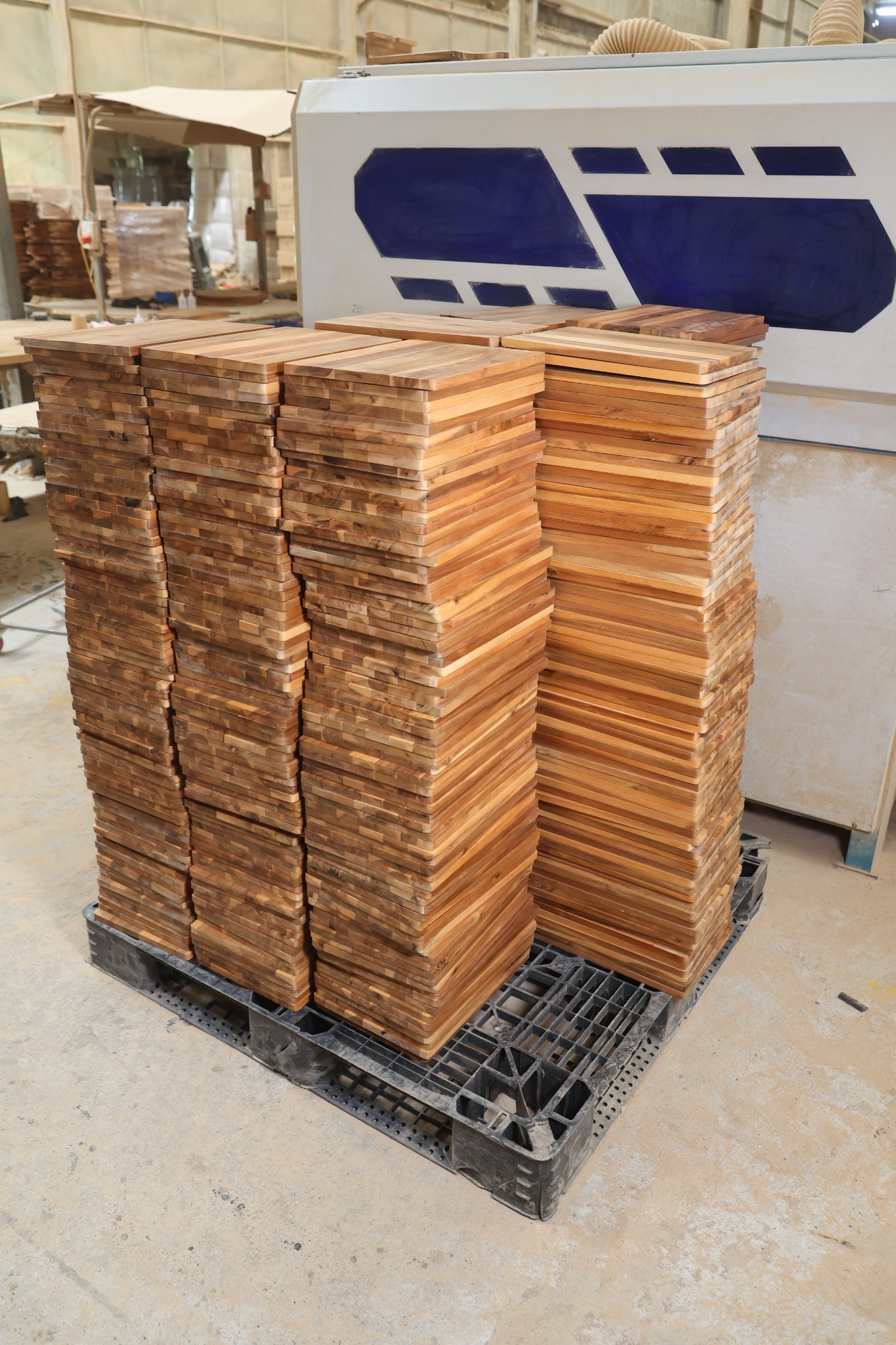
Real product / factory photography from Vietnam production
CONSTRUCTION CHOICES
Describe the board you want to produce.
Format
How to specify it
Common design direction
Face grain
Broad wood faces form the visible top surface.
Appearance-led board and serving designs.
Edge grain
Lengthwise strips are joined with edge surfaces at the top.
Linear strip layouts and kitchen board ranges.
End grain
Wood fiber ends form the top surface in a block layout.
Substantial butcher-block-style designs.
MATERIAL SELECTION
Start with your collection’s appearance.
Acacia and teak offer different visual starting points. Share reference images and discuss acceptable natural color variation. Availability, construction and price are confirmed for your project.
Wood
Visual direction
Buyer discussion
Acacia
Warm tones and expressive natural variation
Agree on desired grain and color range
Teak
Golden-brown tones and a refined wood appearance
Review material availability and target construction
COMPLIANCE & TRACEABILITY
Ask the regulatory questions before you place the order.
Wooden cutting boards are food-contact articles and plant products. The importer should define the destination requirements in the RFQ so the supplier, laboratory and customs broker can prepare the right evidence for the exact SKU.
EU food-contact framework
Regulation (EC) No 1935/2004 applies to materials and articles intended to come into contact with food. For wooden boards, buyers should identify the wood, adhesive, oil or coating and request the test or declaration scope required for their market.
Germany / LFGB
German buyers often specify LFGB-related testing or documentation in addition to EU requirements. Treat “LFGB compliant” as a defined test scope, not a generic marketing certificate: agree the finished article, finish and laboratory protocol before testing.
EUDR for EU timber products
The EUDR applies from 30 December 2026 for large and medium operators and for micro and small operators already covered by the EU Timber Regulation, and from 30 June 2027 for other micro and small operators. EU operators should determine whether the exact product is in scope and what geolocation, legality and due-diligence data they need from the supply chain.
US Lacey Act
The Lacey Act prohibits trade in illegally harvested plants and plant products. APHIS Phase VII expanded declaration coverage to additional plant and wood products, including housewares. Importers should check the current HTS implementation schedule and formal-entry requirements with their broker.
Teak origin traceability
For teak, record the botanical species, country of harvest or source, supplier documents and any legality or chain-of-custody evidence your market requires. Avoid relying on a trade name alone when comparing suppliers.
FDA terminology for the US
Avoid asking whether a wooden cutting board is simply “FDA certified.” Define the intended use and ask for the material, finish and food-contact evidence relevant to the finished article. The FDA Food Code recognizes hard, close-grained wood for cutting boards in food establishments.
Regulatory requirements can change and may depend on tariff code, company size, entry type, material source and destination. Importers should confirm current obligations with their compliance team, laboratory and customs broker before shipment.
“Acacia cutting board, 380 × 260 × 20 mm, edge-grain construction, rounded corners, one-sided juice groove, laser logo on the lower-right corner, printed kraft sleeve. First order: 1,000 pieces per SKU. Destination: United Kingdom. Please quote sampling, bulk production, packaging and proposed shipping terms.”
Example specification only • sizes and quantities are not published product commitments.
SUPPLIER CHECKLIST
Seven things to verify before approving a wooden cutting board supplier.
01
Species & origin
Record wood species, source country and traceability documents required for your market.
02
Moisture target
Agree a target suitable for the product and destination climate, plus the inspection method.
03
Adhesive & finish
Identify the glue system, oil or coating and the food-contact test scope needed for the finished article.
04
Construction
Define face, edge or end grain, strip/block layout, thickness, grooves, handles and edge profile.
05
Golden sample
Use an approved sample or signed reference to define appearance, dimensions and branding.
06
Retail pack
Approve artwork, barcode, labels, inserts, protective packing and master-carton quantities.
07
Inspection & documents
State AQL or inspection expectations, test reports, origin documents and shipping paperwork before the PO.
BEFORE YOU APPROVE
Make the purchase order reflect the product.
01
Confirm the reference
Agree on what defines the sample, appearance and important dimensions.
02
Confirm the documents
State any material, testing or destination documentation needed before ordering.
03
Confirm the commercial terms
Review quantity, packing, payment milestones and delivery scope in the quotation.
04
Confirm repeatability
Retain approved drawings, artwork and packing details for future orders.
BUYER RESOURCES
More practical sourcing guides.
Compare acacia and teak, explore our wholesale sourcing resources and prepare a clearer OEM quotation request.