
Product specifications & order options.
| Material | Acacia; construction and appearance range approved per SKU |
| Standard board sizes | 33 × 23 × 1.8 cm / 35 × 25 × 2 cm; groove adaptation reviewed separately |
| Standard board MOQ | 500 pieces per size, as listed in the catalogue |
| Custom long board | Long board with juice groove; dimensions and MOQ on quotation |
| Groove specification | Width, depth, offset, corner path and face to be routed |
| Finishing & branding | Food-grade oil; laser logo and packaging reviewed with the product |
Choose a catalogue size or a custom long board
Our standard acacia chopping board is available at 33 × 23 × 1.8 cm and 35 × 25 × 2 cm, with a listed MOQ of 500 pieces per size. Use it as a dimensional starting point, and have the requested groove confirmed as part of your custom specification.
Our long acacia board has a juice groove and is made to your dimensions, with MOQ confirmed on quotation. For a different wood pattern, choose a chevron acacia board. These designs have different specifications; request a quotation for the exact board you intend to buy.
Dimension the channel rather than asking for a deep groove
Show the groove width, depth, corner path and offset from the board edge. Define whether it follows the full perimeter, whether there is a collection well and whether one or both faces need routing. These details affect machining, usable surface area and remaining wood thickness.
Keep enough material below and beside the channel for the proposed construction. A simple cross-section drawing makes the requirement clearer than adjectives such as deep or wide. The factory reviews the combination of board thickness, joints, corners and routing before sample approval.
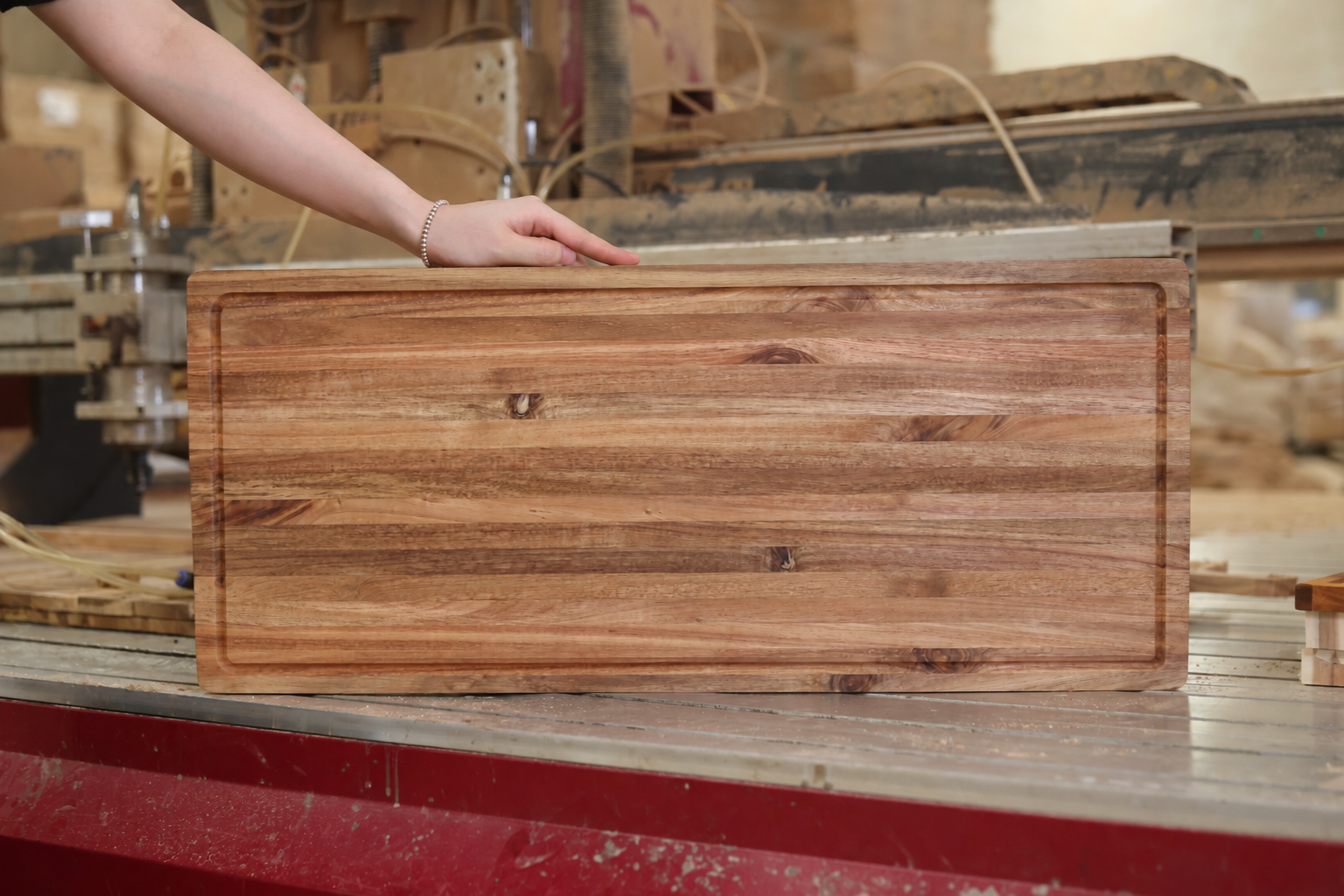
Plan prep, carving and serving functions
A routed channel can help contain liquids during the intended use, while a plain reverse side can offer another working or presentation surface where the design allows. Specify reversible use, handles or side grips explicitly; they are not automatic features of every grooved board.
Acacia has natural colour variation and visible grain. Agree the appearance range, construction and finish so the collection has a common visual direction across sizes. Our size and thickness guide helps relate the dimensions to handling and pack weight.
Inspect routed edges and the complete board
Review channel continuity, clean groove edges, surface smoothness, flatness and finished dimensions against the drawing and sample. Agree how small natural colour differences and the appearance of glued joints will be assessed.
Branding, retail protection and care instructions should be approved with the board. Check that a sleeve or box does not rub against an exposed corner and that the logo remains legible in its agreed position. Read our factory quality-control guide for the purchasing checklist.
Include the groove drawing in your RFQ
Provide the product name and a photo or custom outline, length, width, thickness, material and construction, groove cross-section, quantity per SKU, logo, packaging and destination. State any food-contact testing or supporting documentation needed for the finished product.
The written quotation confirms the scope and MOQ for each reference. Keep the product drawing and packing specification together for repeat orders, and use our OEM RFQ checklist to prepare the brief.
Before you request a quotation.
Is the same groove suitable for every board thickness?
No. Groove depth and position should be reviewed against the finished thickness, grain construction and joints. Send a section drawing so the machining can be evaluated.
Can you make a large carving board with a juice groove?
Send the overall dimensions, thickness, construction, handling features and intended use. Large custom formats are reviewed for timber availability, production feasibility and packing.
Which MOQ should I use?
Our standard acacia chopping board has a minimum of 500 pieces per size. Long boards with juice grooves and custom adaptations require an item-specific quotation. Do not assume the MOQ for one design automatically covers another.